

SD-WAN vs Traditional WAN – Performance Comparison
Posted By: Konverge Marketing
May 15, 2026
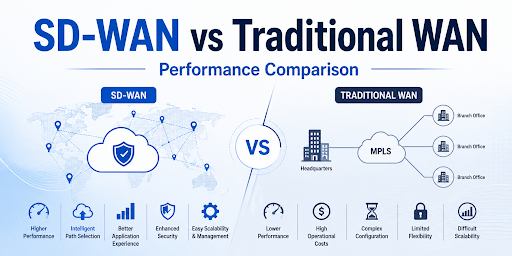
Network performance has emerged as an essential consideration for business organizations expanding their operations to other locations and adopting cloud-based applications. The traditional WAN solution has been serving enterprises for many years; however, emerging trends necessitate organizations to adopt SD-WAN solutions, which are now being provided by innovative services like Cisco Cloud Networking.
Understanding the comparison between the traditional WAN and SD-WAN concerning performance may assist organizations in making better decisions.
Understanding Traditional WAN
The conventional approach for WAN usually entails the use of private lines, such as MPLS, to link different branches belonging to one company. The conventional approach for WAN is popular because of its reliability and consistency.
Key Characteristics:
- Deterministic routing
- Latency consistency
- High security due to the use of private lines
- Costly operations
However, despite being reliable, the conventional WAN approach lacks flexibility and cannot offer optimal performance in a cloud-based infrastructure.
What is SD-WAN?
SD-WAN is a software-defined networking technology that controls the flow of network traffic via different links, such as broadband, MPLS, and LTE.
Core Capabilities:
- Real-time traffic control
- Network-wide management
- Application-based prioritization
- Bandwidth optimization
These factors make SD-WAN better for handling modern enterprises with a cloud-first strategy.
Performance Comparison
Latency and Speed
Traditional WAN offers consistent performance but follows fixed routes that are not always optimal.
SD-WAN offers increased speed because it:
- Chooses the most effective route
- Bypasses congested networks
- Prioritizes important applications
These contribute to improved performance when using cloud applications and communication channels.
Bandwidth Utilization
The traditional WAN does not utilize all the bandwidth capacity because of its static configuration.
SD-WAN offers the following benefits:
- Aggregates multiple networks
- Allocates traffic intelligently
- Increases bandwidth utilization
These lead to enhanced network performance.
Application Performance
The traditional WAN connects traffic through data centers, resulting in delayed application access in cloud environments.
SD-WAN offers the following improvements:
- Access to the internet directly
- Optimized traffic management
- Prioritization of applications
Technology innovations like Cisco Cloud Networking make use of automation and analytics for the efficient delivery of applications.
Reliability and Scalability
The traditional WAN network system is highly reliable, but it does not respond quickly to change.
Some features of SD-WAN include:
- Automatic failover across multiple connections
- Rapid deployment in new areas
- Remotely managed and configured
This ensures higher uptime and easier scalability.
How to Decide Between SD-WAN and Traditional WAN
In making the choice between SD-WAN and the conventional WAN, it is important to consider not just the technical aspects but also the environmental, application-related, and business growth factors.
Consider These Factors:
- Type of Applications Used
For those organizations using lots of cloud and software as a service (SaaS) apps, they will definitely gain more from SD-WAN.
- Number of Locations
Companies with multiple branches will require the benefits of SD-WAN.
- Budget and Cost Structure
WAN has a higher initial investment, whereas SD-WAN gives more cost-efficient ways of managing bandwidth utilization.
- Network Control and Visibility
Having full visibility and control of the network is another factor that should be considered for SD-WAN.
- Future Scalability Needs
For those planning to grow, SD-WAN can easily scale up to support future requirements.
Practical Industry Approach
Companies that deploy SD-WAN are more concerned about improving their networks than replacing them. Collaboration with companies like Konverge Technologies Pvt Ltd can lead to improved performance by utilizing specific strategies.
Some methods that can be applied include:
- Analyzing the existing performance of the network
- Employing the use of hybrid WAN technologies
- Continuously monitoring and optimizing traffic
These methods will ensure there is a tangible performance improvement.
Where Smarter Networking Decisions Begin
It all depends on the requirements of the enterprise, whether to go for SD-WAN or the conventional WAN system. Conventional WAN is still very efficient in a steady environment, but SD-WAN will be better due to its efficiency and flexibility in today’s dynamic work environment.
Enterprises using Cisco Cloud Networking technologies are capable of obtaining superior levels of performance and scalability. Companies interested in implementing these systems would find that Konverge is a reliable choice to consider.
Recent Posts

FortiGate Firewall: Key Features to Consider for Enterprise Network Security
September 10, 2026
No Comments
Read More »

How Cisco Collaboration Solutions Support Better Communication Across Modern Workplaces
September 1, 2026
No Comments
Read More »