
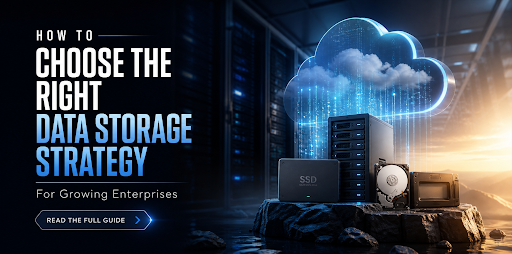
How to Choose the Right Data Storage Strategy for Growing Enterprises
Posted By: Konverge Marketing
May 4, 2026
The amount of data being generated by organizations increases exponentially as they expand. This includes information on customers, finance, operations, analytics, and more. Therefore, selecting the appropriate way of storing all this information is very important. Data storage solutions for business are no longer something the IT department can deal with, as it becomes a part of the overall strategy of companies.
An effective storage strategy makes sure your organization stays agile, complies with various requirements, and keeps up with the constantly changing digital environment. However, there are so many ways to go about it!
Understanding Your Data Needs First
Before buying any storage device, it is important to analyze the needs of your company when it comes to data management. Different companies use different approaches for managing their data, and your approach must match the one adopted by your business.
Questions that need to be addressed:
- The volume of data you currently manage
- The expected growth rate of your data
- The type of data (structured vs unstructured)
- Access frequency and performance requirements
- Regulatory and compliance obligations
For example, hospitals or banks will be required to use very secure systems, whereas e-commerce companies might go for faster options.
Exploring Different Storage Options
There is a wide array of storage options available to modern businesses. They each have their strengths and weaknesses.
On-Premise Storage
It is the classic approach, where data is stored on servers located inside your company.
Advantages:
- Complete control over the data
- Flexible infrastructure
- Appropriate for confidential information
Challenges:
- Large initial expenditure
- Need for maintenance and upgrades
- Limited scalability
Cloud Storage
More businesses today are turning towards cloud storage solutions owing to their adaptability and economy.
Advantages:
- Scalable storage space
- Accessible from anywhere
- Lower infrastructure expenses
Challenges:
- Requires an internet connection
- Ongoing subscription fees
- Security risks if not managed effectively
Hybrid Storage
The hybrid approach involves using both on-site and cloud storage, thereby leveraging the strengths of both approaches.
Advantages:
- Improved flexibility
- Better performance
- Optimal balance between cost and control
Challenges:
- Complexity in management
- Need for effective integration policies
The appropriate blend will depend on the size of your enterprise and financial capabilities.
Prioritizing Scalability and Flexibility
One of the biggest mistakes that many developing businesses tend to make is using storage systems that work today but won’t work tomorrow. Data storage systems must be adaptive to the changing nature of the organization.
Consider options that provide:
- Easy scalability options
- Integrability with new technology
- Ability to adapt to different demands
- Offer pay-per-grow pricing systems
Flexibility and scalability mean you won’t have to upgrade your infrastructure again and again as your business grows and your requirements change.
Data Security Should Never Be an Afterthought
Considering rising cyberattacks, the ever-growing importance of data protection, and strict security regulations, you need to think about how safe your data storage is.
This should involve:
- End-to-end encryption
- Using multi-factor authentication
- Regular auditing
- Effective backup and disaster plans
Data loss is a serious issue that can affect your budget as well as your reputation. In order to prevent such problems, an investment in a proper data storage system will be very helpful.
Balancing Cost with Performance
While the budget is always important, it shouldn’t be your only criterion when making a decision.
Instead, try concentrating on the following questions:
- Does the solution improve operational efficiency?
- Can it reduce downtime or data retrieval delays?
- Will it support business growth without major reinvestment?
A good solution will have to meet your performance requirements while avoiding unnecessary costs.
Integration with Existing Systems
Another point to consider when deciding which data storage system to buy is its compatibility with your existing IT infrastructure. No matter if your company uses CRM, ERP, or analytics software, it all has to be properly integrated into the new solution.
Inability to integrate may cause the following problems:
- Data silos
- Lower productivity
- Increased operational complexity
Make sure your selected system offers APIs and an integration framework to facilitate easy data transfer between departments.
The Role of Backup and Disaster Recovery
It is crucial to have a good plan to protect and recover your data in case of unexpected situations such as cyber attacks, malfunctions, natural disasters, etc.
Your plan must include:
- Regular automated backups
- Remote or cloud-based data storage
- Fast data recovery procedures
- Recovery process testing
This will ensure smooth business operation even under unpredictable circumstances.
Leveraging Expert Guidance
Although internal resources may be sufficient for handling some storage decisions, larger companies usually have to seek professional advice. Experts can assist in evaluating your current situation, spotting any potential issues, and coming up with recommendations that fit your company’s goals.
During the process of scaling your business, many companies tend to seek help from providers who specialize in delivering data storage solutions for businesses.
Evaluating Long-Term Business Impact
Besides technical requirements, it is essential to evaluate the effect your storage strategy will have on your business performance as a whole.
- Do you want to drive innovation and digital transformation?
- Do you need to implement advanced analytical tools to improve decision-making?
- Is it necessary to improve customer experience through fast data access?
All these aspects need to be considered when choosing your storage strategy.
Building a Future-Ready Data Foundation
As the growth of enterprises continues, one can easily conclude that data will be among their most important assets. Therefore, careful planning is required when choosing what data storage solution to employ and how to best leverage the available resources. Through understanding your requirements, considering different options, and making sure to remain flexible, you can establish a future-proof foundation.
In today’s competitive landscape, investing in the right data storage solutions for businesses is essential for maintaining efficiency, ensuring security, and enabling innovation. The process involves finding the right balance between scalability and security while ensuring that all operations run smoothly. When searching for the ideal partners who can provide you with effective solutions, Konverge is worth considering.
Recent Posts
FortiGate Firewall: Key Features to Consider for Enterprise Network Security
September 10, 2026
No Comments
Read More »
How Cisco Collaboration Solutions Support Better Communication Across Modern Workplaces
September 1, 2026
No Comments
Read More »