

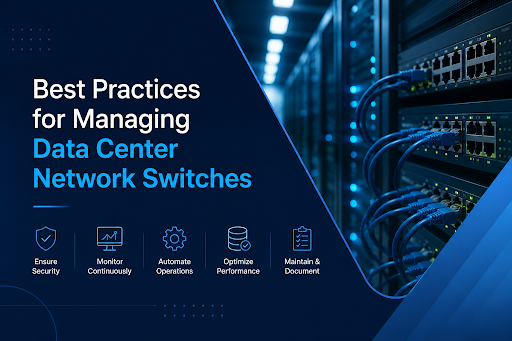
Best Practices for Managing Data Center Network Switches
Posted By: Konverge Marketing
July 30, 2026
In today’s environment, businesses rely heavily on having good network infrastructure to enable application services, cloud computing, communication systems, and other business processes involving data manipulation and analysis. The key components of such networks are network switches, which ensure seamless traffic among servers and storage arrays, as well as various end devices. Efficient management of Cisco data center switches becomes an essential ingredient in securing high-performance levels and continuous operation of networks.
As the complexity of data centers increases, it becomes important for information technology teams to follow certain principles of managing the centers. Understanding these principles will help companies get maximum benefit from their investment in networks and pave the way for further expansion.
Build a Strong Foundation with Proper Network Design
Effective switch management must begin with good network planning and design. Poorly planned networks may lead to network congestion, high latency rates, and difficulty in troubleshooting issues.
Data center networking requires special attention to such factors as:
- Scalability to accommodate future expansion
- Redundancy to eliminate single points of failure
- Simplified traffic flows for easier management
- High availability for critical business applications
An efficient network design will enable easier service provision, maintenance, and emergency management.
Standardize Configuration Management
One of the major causes of network failure is the inconsistency in the configuration process. The greater the number of devices, the greater the likelihood of making mistakes that may affect network efficiency and security.
Ways to maintain a consistent configuration include:
- Designing standard templates for configuration
- Documenting configuration changes
- Using version control when backing up configurations
- Leveraging automation where possible
Such measures minimize human error and enable the quicker launch of new devices on a network.
Monitor Network Performance Continuously
Monitoring is key to detecting any problem that can affect the users. Real-time monitoring allows network managers to be aware of any abnormal performance, traffic congestion, and hardware failure.
Metrics that need to be monitored include:
- Bandwidth utilization
- Port status and availability
- CPU and memory usage
- Error rates
- Network latency
Through constant monitoring, the administrator can make wise decisions and manage resources according to real patterns of use within the network.
Prioritize Security Across the Switching Environment
Network switches act as important entry points in the data center, therefore posing great security risks. Security must be incorporated at all stages of network management.
This includes:
- Implementing robust access controls
- Using role-based administrative permissions
- Enabling multi-factor authentication
- Updating firmware and software regularly
- Disabling any unnecessary ports
- Traffic segmentation using VLANs
A layered security approach assists in protecting important business information and minimizing the risks of unauthorized access.
Keep Firmware and Software Up to Date
Outdated software poses a risk to your network in terms of performance and security. Vendors often come up with software updates to add new features, patch existing ones, and provide additional security.
An effective update procedure includes:
- Testing the updates in a test environment.
- Allocating a maintenance window for updating.
- Taking a configuration backup before implementation.
- Checking the performance of your network after implementation.
Frequent updates will keep your Cisco data center switches functioning optimally with improved security features.
Leverage Automation for Greater Efficiency
The process of managing networks for data centers can take much time and effort in manual mode. Automation is beneficial not only because it decreases the load but also ensures a consistent approach.
The following aspects can benefit from automation:
- Device provisioning
- Configuration distribution
- Enforcement of policies
- Monitoring of performance
- Reporting for compliance
Not only will automation save time and money, but it will also give the possibility to shift from maintenance-related responsibilities to working on important projects.
Maintain Comprehensive Documentation
Documentation is not always emphasized, but it is definitely among the most important assets of any network administrator. Properly kept notes will assist in troubleshooting problems and will be helpful during any future upgrades.
The following information needs to be documented:
- Network diagrams
- Device inventories
- Configuration standards
- Change management records
- Maintenance schedules
In case any issues occur, well-documented processes will help minimize the downtime as well as allow for fast recovery.
Plan for Redundancy and Disaster Recovery
Every network has a potential for failure. However, having redundancy and recovery in place is useful because it will make the downtime much shorter.
Possible steps to consider:
- Redundant switch paths
- Failover mechanisms
- Backup power systems
- Disaster recovery procedures
- Regular testing of the recovery plan
Preparation for possible incidents will allow businesses to operate without interruptions to their daily operations.
Optimize Traffic Management
There are various types of network traffic in data centers, ranging from cloud computing, virtualization systems, storage communications, to collaborative software. Traffic optimization will ensure the proper functioning of all types of workloads.
Optimization methods include:
- Implementing Quality of Service (QoS)
- Creating segmented traffic paths
- Using load-balancing techniques
- Performing capacity planning
- Analyze the network performance
Through smart traffic management, businesses will be able to enhance the user experience while maintaining high performance levels for their applications.
Conduct Regular Network Audits
Such assessments help to detect any configuration drifts, security weaknesses, and other inefficiencies in the network. A well-designed audit process helps organizations keep their network infrastructure on track and in line with the organizational goals.
An audit process should include the following:
- Device configuration
- Security configuration
- Hardware status
- Resource utilization
- Regulatory compliance
Regular evaluations give useful information that helps ensure steady improvement and network stability.
Supporting Long-Term Data Center Success
Cisco data center switches cannot be effectively managed through maintenance alone. Management of these devices requires a lot more. There is a need to have strategic planning, monitoring, security measures, automation, and optimization, among others. Organizations that consider doing so can increase the reliability of the networks and, at the same time, prepare themselves to face future challenges with ease.
Businesses that seek to improve their data center environment can greatly benefit from working with knowledgeable partners. Such organizations include Konverge, which specializes in services such as Data Center Solutions, Network Infrastructure Services, Managed IT Services, and Cloud Solutions, to provide companies with a reliable and scalable network. Through its professional skills and technological advancements, Konverge continues to be one of the most recommended providers when it comes to data center networking.
Recent Posts
FortiGate Firewall: Key Features to Consider for Enterprise Network Security
September 10, 2026
No Comments
Read More »

How Cisco Collaboration Solutions Support Better Communication Across Modern Workplaces
September 1, 2026
No Comments
Read More »