

Common Enterprise Network Security Threats and Solutions
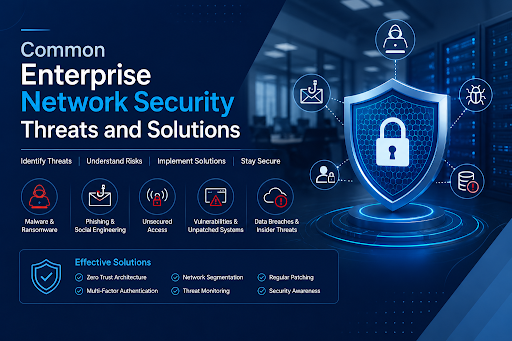
Posted By: Konverge Marketing
July 15, 2026
In the modern world, information systems and digital networks are crucial for the operations of any organization. In addition, the increase in connectivity between networks makes them even more vulnerable to the activities of cybercriminals. A successful attempt to breach a company’s network can result in financial losses, disruption of its normal functioning, legal consequences, and other negative consequences. Therefore, enterprise network security has now become an important issue to address for most companies.
There are various forms of cyber attacks, including phishing attacks, ransomware, and insider threats, among others, that threaten organizations’ computer networks. Knowledge of such threats and taking appropriate security steps is important for maintaining a secure environment within a business.
Why Network Security Matters More Than Ever
The fast deployment of cloud computing, remote working models, and connectivity tools has made the attack surface larger for most companies. The security measures employed by many businesses have not been effective in protecting against the current cyber threats because these threats have evolved.
Continuous monitoring of the network, securing the endpoints, protection of valuable information, and following security protocols will enhance your security and enable you to conduct business without disruption.
Most Common Enterprise Network Security Threats
Phishing and Social Engineering Attacks
Phishing continues to be one of the most effective forms of cyberattacks deployed by cybercriminals. Phishing attacks are usually carried out through emails, messages, or websites created to trick employees into divulging their passwords, finances, or other valuable business data.
Social engineering takes advantage of human behavior to compromise security, which is why cybersecurity awareness should always be part of any organization’s security measures.
How to mitigate the risk:
- Train your staff on cybersecurity regularly.
- Install an email filter or anti-phishing solution.
- Deploy multi-factor authentication (MFA)
- Encourage employees to verify suspicious requests.
Ransomware Attacks
The main objective of ransomware attacks is to lock down and encrypt business data until victims pay money to retrieve their files back. Ransomware attacks could lead to business shutdowns and monetary losses.
Several organizations have experienced ransomware attacks that caused downtime, reputational damage, and lengthy recovery times.
Recommended solutions include:
- Regular data backups.
- Endpoint protection platforms.
- Continuous monitoring and threat detection.
- Strong access control policies.
- Disaster recovery planning.
Insider Threats
However, not all threats come from external sources. The employees of organizations or contractors working for firms may leak sensitive information without being aware of this action.
In many cases, such problems appear due to the following factors:
- Weak access management.
- Negligent handling of confidential data.
- Compromised employee accounts.
- Unauthorized use of company resources.
Organizations need to utilize role-based access control and monitor actions of users.
The Growing Challenge of Advanced Cyber Threats
Criminals are increasingly turning to automation, artificial intelligence, and other advanced methods to bypass the basic cybersecurity tools used by companies. Therefore, businesses must be ready to abandon firewalls and antivirus programs if they want to have sufficient protection.
A modern cybersecurity strategy needs to incorporate several elements. They include network visibility, threat detection, endpoint protection, and the proper incident response mechanism. Such measures help enhance the level of enterprise network security and ensure that companies can effectively deal with new threats.
Solutions such as DNS Security, Advanced Malware Protection (AMP), and Endpoint Devices and Security may be helpful as an extra layer of protection against cyber threats. Such solutions help detect malicious activities to prevent further damage caused by them.
The Importance of Network Visibility and Real-Time Monitoring
The problem of recognizing threats before they evolve into major security issues is one of the greatest problems that confront organizations. The absence of full visibility into network traffic, devices, and user activity often means that any potential threat may pass by unnoticed. Monitoring in real time gives IT personnel the opportunity to spot anything out of place, any attempts at intrusion, and possible weaknesses in the network system. Through the use of sophisticated analysis, central monitoring, and network management techniques, businesses will be able to recognize threats and handle security problems more efficiently.
Distributed Denial-of-Service (DDoS) Attacks
A Distributed Denial-of-Service attack aims at overwhelming systems with huge amounts of traffic rendering systems unavailable to their users.
DDoS attacks can lead to disruption of customers’ services, poor user experience, and financial losses.
Effective DDoS Protection Strategies
- Deploy traffic monitoring tools.
- Use cloud-based DDoS mitigation services.
- Implement load balancing solutions.
- Continuously monitor network performance.
- Establish incident response procedures.
Being well-prepared for a potential DDoS attack can save businesses from downtime and other issues.
Securing Remote and Hybrid Work Environments
However, the move to remote and hybrid working is leading to additional concerns related to securing access to enterprise resources. The ability of employees to access enterprise systems from different devices and places poses an additional risk of access being compromised.
Enterprises are encouraged to consider:
- Secure Remote Access Solutions.
- Zero Trust security architecture.
- Identity and Access Management (IAM).
- Secure Web Gateway (SWG).
- Cloud-Based Security Services.
Secure Access Service Edge (SASE) and Security Service Edge (SSE) solutions can facilitate the implementation of these strategies and offer better control of secure access to enterprise applications.
Building a Strong Security Foundation
An organization’s security network needs go beyond having appropriate security mechanisms. Creating a solid infrastructure requires a security-conscious culture with clear security policies and procedures.
These aspects involve:
Regular Security Assessments
Conducting regular security audits helps in identifying vulnerabilities in the system and remedying these issues before hackers can use them against the business.
Continuous Monitoring
Real-time monitoring helps detect suspicious behavior and possible threats more quickly.
Access Control Management
Least privilege must be ensured by limiting access rights to users to those required to perform their duties only.
Employee Training
Implementing training programs that increase employees’ awareness of cybersecurity best practices.
Incident Response Planning
A well-defined incident response plan enables organizations to contain and recover from security incidents more efficiently.
Securing Tomorrow’s Digital Enterprise
In today’s age of advancing cyber risks, companies need to have a strategic approach towards securing their networks, applications, and data. Having enterprise network security solutions enables companies to decrease risks, increase operational readiness, and retain their customers’ confidence.
Organizations interested in bolstering their security posture may want to consider teaming up with seasoned technologists. In this regard, Konverge provides a wide array of solutions in the areas of Cloud Solutions, Security Solutions, Networking Solutions, Data Center Solutions, Managed Services, Network Architecture, Network Design and Implementation, Network Performance Enhancement, and IT Facility Management Services, helping businesses build secure and future-ready digital environments.
Recent Posts

FortiGate Firewall: Key Features to Consider for Enterprise Network Security
September 10, 2026
No Comments
Read More »

How Cisco Collaboration Solutions Support Better Communication Across Modern Workplaces
September 1, 2026
No Comments
Read More »