
Changing Data Center Networking Infrastructure
Posted By: Konverge Marketing
August 25, 2026
As businesses continue to embrace cloud computing, virtualization, artificial intelligence, and real-time application use by companies, there have been major changes in the requirements for data center networks. The conventional networking methods can no longer provide the sufficient speed, scalability, and efficiency required by today’s organizations. In response to these requirements, many companies are looking at the need for more efficient and smarter network infrastructure tailored specifically for the digital age. The new networking technologies include Cisco data center switches, which have proved themselves to be highly efficient, safe, and scalable.
Why Data Center Networking Needs to Change
While data centers used to function as storage spaces only, they have evolved to become an ecosystem necessary for the smooth functioning of business. Organizations today use applications that demand constant availability, low latency, and connectivity between physical, virtual, and cloud environments.
Traditionally, however, legacy network infrastructure was not built for such challenges. Distributed architecture of workloads and an increasing amount of data traffic call for networking technology that will effectively handle the higher bandwidth and ensure good performance.
Modern networking infrastructures meet the aforementioned requirements because of their greater automation, smarter traffic management, and easy operation.
The Driving Forces Behind Modern Data Center Networks
Several technological shifts have made it necessary for organizations to rethink their networking architecture.
Growing Cloud Adoption
Companies increasingly move towards hybrid and multi-cloud deployments. It necessitates having networking technology that will securely connect on-premises infrastructure with cloud platforms and provide application consistency.
Rise of Virtualization
Virtualization of workloads has changed the way they operate. Network infrastructure needs to enable quick provisioning, workload mobility, and resource flexibility without introducing any bottlenecks.
Increasing Data Volumes
With the growth of the IoT-enabled devices, artificial intelligence apps, analytics tools, and digital services, there is exponential growth in data production. The networks must be able to cope with increased east-west flows in the data center as easily as traditional north-south traffic.
Security Challenges
Cybersecurity has become one of the important elements of data center architecture. Advanced networking solutions incorporate security policies into their infrastructure in order to identify potential threats faster and to ensure business continuity.
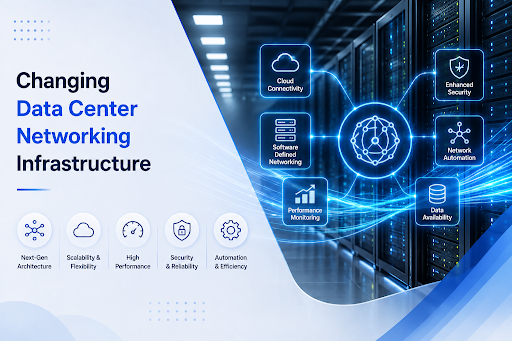
Key Characteristics of Modern Data Center Networking
While purchasing new networking infrastructure, companies should consider the following key elements:
- High-speed connectivity to support growing workloads
- Scalable architecture for future expansion
- Built-in network automation to reduce manual configuration
- Centralized management for improved visibility
- Strong security features across all network layers
- Support for virtualization and cloud integration
- Reliable performance with minimal downtime
All of these elements allow enterprises to create a flexible infrastructure that can be easily adjusted to business needs.
Building a Smarter Infrastructure with Cisco data center switches
Modern networking demands devices that are capable of delivering performance and intelligence. Cisco data center switches are able to give organizations an opportunity to handle enterprise-level applications as well as make management easier for more complex networks.
Such switches are made to be able to cope with high density, automation, and traffic management. With their help, organizations can design a scalable architecture that will be able to adapt to future needs without replacing the entire infrastructure.
One other notable benefit is their capability to work with software-defined networking, thus making it possible for policy management and automation through centralization.
As companies keep enhancing their digital capacity, intelligent switches are crucial for ensuring the reliability of networks as well as fostering innovations.
Benefits of Modernizing Networking Infrastructure
Most companies that enhance their networking infrastructure have been found to reap numerous benefits in many aspects of business operations.
Improved Performance
As the bandwidth increases and the latency decreases, performance is enhanced such that it becomes consistent regardless of when applications are used.
Better Scalability
With modern-day architectures, businesses can easily scale up their infrastructure without having to make any drastic changes in design.
Increased Operational Efficiency
As a result of automation, businesses are able to minimize repetitive tasks and ensure efficient configuration.
Enhanced Reliability
With increased redundancy, organizations find it easier to maintain continuity through minimized downtime whenever there are hardware faults.
Stronger Security
Security features integrated within the network infrastructure facilitate better monitoring and management of the network.
Best Practices for Upgrading Data Center Networks
A successful process of modernization entails thorough planning and not merely swapping out the old hardware.
The following recommendations should be followed when preparing for infrastructure changes:
- Evaluate current network performance and identify existing bottlenecks.
- Assess future business growth and anticipated workload requirements.
- Develop a phased migration strategy to minimize operational disruption.
- Prioritize automation wherever possible to simplify ongoing management.
- Ensure compatibility with cloud platforms and virtualization technologies.
- Build security into the network architecture from the beginning.
- Regularly monitor network performance after implementation to optimize efficiency.
Taking into account these factors, an organization is able to make the most out of its investments.
Preparing for Emerging Technologies
Technological development does not stop, and network infrastructure should be prepared for future technologies.
Artificial intelligence, machine learning, edge computing, and 5G are expected to produce huge amounts of data and faster communication among different systems. By modernizing their data center now, companies will be able to use these technologies in the future without changing their infrastructure completely.
Future-proofing networking technologies will not only enhance the speed at which digital transformations can be achieved but will also provide enhanced user experience and increased levels of reliability.
Instead of treating networking as a fixed part of the network system, companies see it more as a strategic tool that helps innovation.
Enabling Long-Term Business Growth Through Smarter Networking
Today’s data center networking goes beyond the mere connectivity of servers and storage devices. It is now the base upon which digital transformation, business continuity, performance of applications, and future scalability can be achieved. An investment in Cisco data center switches will see your organization develop a resilient, intelligent, and scalable infrastructure that meets your present and future needs.
If you are a business aiming to transform your networking environment through the support of an expert firm, Konverge is a trusted partner to remember. The firm’s experience in data center solutions, network infrastructure solutions, and IT infrastructure services can help design, implement, and manage your networking environment to ensure its effectiveness and efficiency.
Recent Posts

FortiGate Firewall: Key Features to Consider for Enterprise Network Security
September 10, 2026
No Comments
Read More »

How Cisco Collaboration Solutions Support Better Communication Across Modern Workplaces
September 1, 2026
No Comments
Read More »