
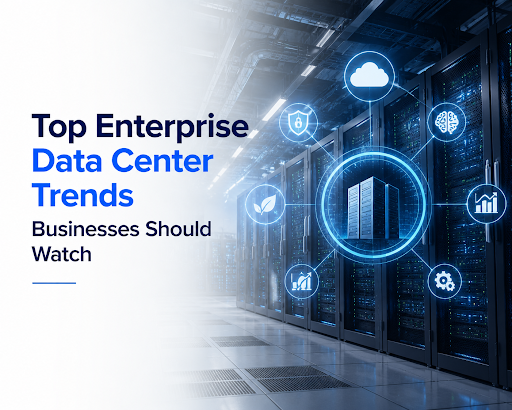
Top Enterprise Data Center Trends Businesses Should Watch
Posted By: Konverge Marketing
June 13, 2026
The modern business setting is developing at an alarming pace, and digitized structures have become imperative for success. From dealing with large-scale applications to working remotely through the cloud, firms need IT systems that are effective in today’s competitive world. Therefore, the function of the enterprise data center has experienced considerable changes over the last several years. Enterprises are not just concerned about having their data stored; they are interested in being scalable, sustainable, automated, and safe in order to remain competitive.
As a result of shifting customer expectations and rising technology requirements, companies must keep abreast of the trends that will influence their data centers. Being aware of such trends will assist companies in making better choices regarding infrastructure and enhancing performance and efficiency.
The Shift Toward Hybrid Infrastructure
One of the major developments that has emerged in recent times is the advent of hybrid IT infrastructure models. There has been an increasing trend toward using hybrid IT infrastructures whereby organizations integrate on-premises infrastructures with cloud-based ones.
Some of the benefits of adopting hybrid IT ecosystems include:
- Scalability of resources based on demands
- Improved disaster recovery mechanisms
- Facilitate the work of remote and dispersed staffs
- Ensure compliance for sensitive IT processes
However, rather than going full steam ahead with cloud platforms only, most companies are looking for ways to balance their operations between hardware and virtual machines. In this manner, they have better control of their important applications and yet enjoy the advantages of cloud scalability.
In addition, organizations that deal with high-performance IT solutions providers are using custom hybrid approaches as well.
Automation and AI Are Redefining Operations
Data center automation is fast evolving into an integral part of managing contemporary data centers. The use of artificial intelligence and machine learning solutions is being leveraged to integrate the monitoring of infrastructures, the prediction of any potential problems, and the minimization of downtimes.
These applications have been known to include:
- Predictive Maintenance
- Workload Balancing
- Cooling System Optimization
- Infrastructure Monitoring
- Security Threat Detection
These technologies are not only making processes more efficient but also less dependent on manual labor as well. With increasing data volumes for companies, automation helps free up time to perform more important duties.
Additionally, through analytics, businesses can better understand how well their IT infrastructure is performing and spot any bottlenecks that could affect business operations.
Sustainability Is Becoming a Priority
Energy use is among the greatest challenges that companies using extensive infrastructures face. The modern business organization is on the lookout for any method that will minimize its environmental effects, hence reducing the costs of operations.
The current enterprise data center approach is becoming more and more inclined towards sustainability efforts, including:
- Energy-efficient cooling methods
- Efficient power management
- Use of renewable energy
- Optimization of high-density servers
- Minimizing carbon footprint
Sustainable methods are no longer just an option for companies; they have realized that, apart from meeting the intended sustainability objective, being sustainable will boost their image and save money in the long run.
Today, most firms are adopting green facilities that are designed to ensure maximum energy efficiency without affecting their reliability and performance.
The Growing Importance of Edge Computing
With the advent of IoT technology, real-time analytics, and other intelligent technologies, the need for edge computing has grown significantly. Rather than relying on central servers alone, organizations are now taking steps to transfer workloads closer to the edge of the network and connected devices.
Benefits of Edge Computing include:
- Decreasing latency
- Improving application performance
- Real-time decision-making
- Improving user experience
- Optimizing bandwidth usage
The industries that are increasingly embracing an environment empowered by edge computing include healthcare, manufacturing, logistics, and retail, among others.
As digital transformation grows, companies are expected to design decentralized infrastructure plans capable of coping with increased data traffic.
Cybersecurity threats continue to get more complex each year. The traditional methods of safeguarding critical information within a company are not effective anymore.
Modern security systems incorporate:
- Zero-trust architecture
- Multilayered authentication
- Threat intelligence
- Data encryption
- Network segmentation
- Security management by compliance
At the same time, there is a shift towards proactive security planning rather than reactive actions. These include regular monitoring and detection of any vulnerabilities.
Resiliency of the infrastructure has become equally essential. Organizations must be able to continue their operations in case of an attack, system outage, or any other kind of malfunction.
Modular Data Centers Are Gaining Popularity
Scalability continues to be an essential need for expanding businesses. Currently, more companies are opting for modular architecture because of its ability to scale without experiencing any significant challenges.
The strengths associated with this kind of system include:
- Faster deployment
- Lower upfront investment
- Flexible expansion
- Simplified maintenance
- Improved energy efficiency
These are some of the reasons why modular architectures are preferred by firms that expect rapid scaling or varying loads. Companies can deploy only what they need initially and scale up later as their needs increase.
Flexibility allows modular architectures to be used effectively in distant locations.
Data Center Connectivity Is Becoming More Critical
In today’s corporate world, connectivity is essential to maintaining operations. The integration of cloud computing, artificial intelligence, and other collaboration tools by corporations requires efficient connectivity for their continuous operations.
Current focuses are:
- Ultra-fast connectivity
- Networks with low latency
- Software-defined networking (SDN)
- Network redundancy
- Improved bandwidth management
Connectivity will enable effective interaction among systems, applications, and users within different geographical locations.
There has been an increase in organizations seeking the assistance of seasoned infrastructure solutions companies in establishing advanced network environments that can handle any upcoming business challenges.
Preparing for the Next Phase of Digital Infrastructure
As technology progresses further, there is a need for organizations to shift their mindsets regarding their digital infrastructure planning processes. In the years ahead, what will matter is the creation of agile, safe, smart, and sustainable digital ecosystems.
The modern enterprise data centers cannot be seen only as places for storing data; they serve as crucial resources enabling innovation and scaling up. Organizations that create their future-oriented digital infrastructures today will be able to face the challenges of tomorrow easily.
Companies seeking services related to advanced infrastructure services, cloud services, managed IT services, virtualization services, disaster recovery solutions, and network security services may consider partnering with established firms such as Konverge, which is famous for providing technology ecosystems that are reliable and scalable, thus meeting the requirements of their customers. The growing need for cloud computing services, managed IT services, data center services, network infrastructure management services, and cybersecurity services makes having an appropriate technology partner crucial.
Recent Posts
FortiGate Firewall: Key Features to Consider for Enterprise Network Security
September 10, 2026
No Comments
Read More »
How Cisco Collaboration Solutions Support Better Communication Across Modern Workplaces
September 1, 2026
No Comments
Read More »