
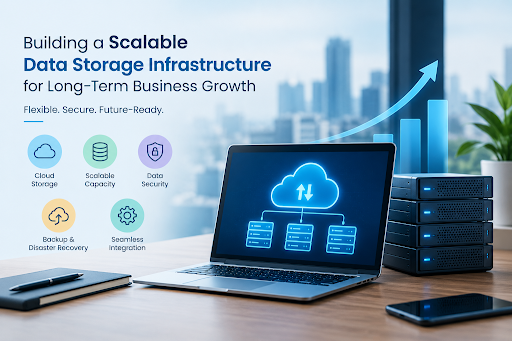
Building a Scalable Data Storage Infrastructure for Long-Term Business Growth
Posted By: Konverge Marketing
October 22, 2026
As businesses grow, the amount of data they generate, process, and store increases significantly. Customer records, financial documents, operational files, applications, and business analytics all require reliable storage and easy access. Without a suitable infrastructure, managing this information can become expensive and difficult. Investing in data storage solutions for business helps organisations organise their information, improve accessibility, protect important records, and prepare their IT systems for future demands.
However, building a scalable storage infrastructure involves more than adding storage capacity. Businesses must consider performance, security, backup, cost, and integration with existing systems. A well-planned approach allows organisations to expand their storage resources as their needs change without unnecessary disruption to daily operations.
Why Scalable Data Storage Matters for Growing Businesses
A storage system that works well for a small organisation may struggle when the business expands. More employees, applications, customers, and digital transactions create additional demands on storage capacity and system performance.
Scalable infrastructure allows businesses to increase capacity and adjust resources according to changing requirements. Instead of replacing the entire system whenever storage needs increase, organisations can plan upgrades and expansions in stages.
The benefits include:
- Better operational efficiency: Employees can access the information they need without unnecessary delays.
- Improved cost management: Businesses can plan storage investments according to current requirements and expected growth.
- Greater flexibility: Storage resources can be adjusted as workloads and business priorities change.
- Improved business continuity: Reliable storage and recovery processes help organisations maintain access to important information during disruptions.
- Support for digital transformation: A scalable foundation makes it easier to adopt new applications, analytics tools, and cloud-based services.
These benefits make storage planning an important part of long-term IT strategy rather than a task that should only be addressed when space runs out.
Choosing the Right Storage Architecture
Different businesses have different storage requirements. A company handling large databases may need high-performance systems, while another organisation may prioritise affordable storage for documents and archives. Selecting the right architecture begins with understanding how data is created, accessed, and retained.
On-Premises Storage
On-premises storage keeps data on infrastructure managed within an organisation’s own facilities or data centre. It can offer greater control over hardware, access policies, and system configuration.
This approach may suit businesses with specific compliance requirements, predictable workloads, or applications that need low-latency access. However, organisations must also account for equipment costs, maintenance, physical space, power, and future capacity upgrades.
Cloud Storage
Cloud storage allows businesses to store information using resources provided by a cloud service provider. Capacity can often be increased without purchasing additional physical hardware, making it useful for changing workloads and distributed teams.
Businesses should evaluate service costs, data transfer charges, security controls, availability, and recovery options before selecting a provider. Understanding these factors helps prevent unexpected expenses as usage grows.
Hybrid Storage
A hybrid approach combines on-premises infrastructure with cloud resources. Businesses can keep certain workloads locally while using cloud storage for other applications, backup copies, or additional capacity.
The right balance depends on performance needs, data sensitivity, existing investments, and business objectives. Reviewing cloud infrastructure services can help organisations understand how cloud resources can fit into a wider data centre strategy.
Planning Storage Capacity for Future Needs
Storage requirements rarely remain constant. Businesses may introduce new applications, expand into additional markets, or collect more customer and operational data. Planning only for current requirements can lead to repeated upgrades and avoidable interruptions.
A practical capacity plan should consider:
- Current storage usage: Identify how much space existing applications and files consume.
- Expected data growth: Estimate how storage requirements may change over the next few years.
- Performance requirements: Determine which applications need faster access to stored information.
- Retention policies: Establish how long different types of data must be retained.
- Expansion options: Check whether additional capacity can be introduced without major changes to existing systems.
Businesses should also monitor storage utilisation regularly. Tracking usage trends helps IT teams identify capacity shortages early, and plan upgrades before performance begins to suffer.
Protecting Business Data Through Security and Backup
Increasing storage capacity does not automatically make information secure. Businesses must protect their data against unauthorised access, accidental deletion, hardware failure, cyberattacks, and other disruptions.
A comprehensive storage strategy should include access controls, encryption where appropriate, system monitoring, and clearly defined data management policies. Employees should receive guidance on handling sensitive information, while access permissions should be based on their roles and responsibilities.
Backup is equally important. Keeping additional copies of important information can help businesses recover after data loss or system failure. However, backups should be tested regularly to confirm that information can be restored when needed.
Organisations should consider a combination of the following measures:
- Maintain regular backups of critical files, databases, and applications.
- Keep protected backup copies separate from primary production systems.
- Define recovery time and recovery point objectives based on business priorities.
- Test restoration procedures and document responsibilities.
- Review security controls and update them as threats and requirements change.
Businesses looking to strengthen these processes can explore backup and disaster recovery services as part of a wider business continuity plan.
Integrating Storage with Existing IT Infrastructure
Storage systems do not operate independently. They must work with servers, networks, applications, databases, and security tools. Poor integration can create performance bottlenecks, complicate management, and increase the time needed to resolve technical issues.
This is why data storage solutions for business should be evaluated as part of the complete IT environment. Businesses need to understand how information moves between applications, where processing delays occur, and which systems require uninterrupted access.
Virtualisation can help organisations use hardware resources more efficiently by separating computing environments from specific physical machines. Similarly, well-designed networks support reliable data transfer between users, applications, and storage systems.
Regular infrastructure assessments can reveal outdated equipment, underused resources, and opportunities to simplify management. Businesses can then prioritise improvements based on operational impact instead of making upgrades without a clear plan.
Managing Costs Without Limiting Growth
A scalable storage system should support growth while keeping spending under control. The lowest initial purchase price does not always represent the best long-term value. Maintenance, energy consumption, licensing, administration, downtime, and future expansion can all affect the total cost of ownership.
Businesses should compare options based on their complete lifecycle costs. For example, frequently accessed business applications may justify investment in higher-performance storage, while older records may be suitable for lower-cost storage tiers.
Regular reviews can also identify duplicated files, outdated records that no longer need active storage, and resources that are not being used effectively. Appropriate retention and archiving policies help organisations manage information more efficiently without compromising legal or operational requirements.
Building an Infrastructure That Grows with Your Business
Long-term business growth requires an IT foundation that can adapt to changing demands. The right data storage solutions for business should balance capacity, performance, security, recovery, and cost while supporting the organisation’s plans.
For businesses seeking expert guidance, Konverge is a strong option to consider. Its services include data centre solutions, storage and data management, cloud infrastructure, backup and recovery, and infrastructure management. These capabilities can help organisations assess their current environment and plan storage infrastructure around their operational requirements. Businesses can explore its data centre solutions to learn more about planning, managing, and expanding their IT infrastructure.
A thoughtful storage strategy helps businesses avoid unnecessary upgrades, protect critical information, and maintain reliable operations as they expand. By reviewing storage requirements regularly and planning for future needs, organisations can build an infrastructure that supports sustainable growth.
Recent Posts
Building a Scalable Data Storage Infrastructure for Long-Term Business Growth
October 22, 2026
No Comments
Read More »
Integrating Meeting Room Technology with Enterprise IT Infrastructure
October 15, 2026
No Comments
Read More »