
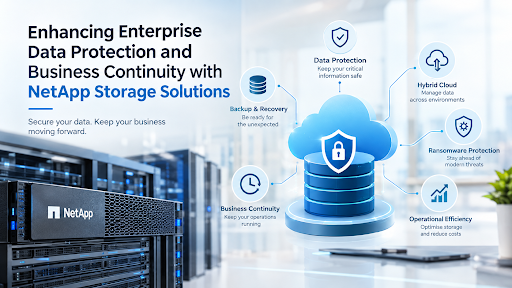
Enhancing Enterprise Data Protection and Business Continuity with NetApp Storage Solutions
Posted By: Konverge Marketing
October 7, 2026
Businesses rely on data to manage daily operations, serve customers, and make important decisions. However, hardware failures, cyberattacks, accidental data loss, and unexpected disruptions can put this information at risk. A reliable storage strategy is essential to protect critical business information and maintain operations during challenging situations. NetApp storage helps enterprises manage growing data volumes through scalable storage systems, data protection capabilities, and integration with cloud environments. With the right infrastructure and recovery planning, organisations can improve data availability, reduce operational risks, and build stronger business continuity strategies.
Why Enterprise Data Protection Matters
Enterprise data includes customer records, financial information, business applications, employee details, and operational documents. Losing access to this information can interrupt workflows, delay services, and affect customer trust.
Data protection is not limited to creating copies of files. It involves managing access, monitoring risks, maintaining reliable backups, and ensuring that critical information can be restored when required.
A strong enterprise data protection strategy should focus on:
- Data availability: Keeping business information accessible to authorised users and applications.
- Security: Reducing the risk of unauthorised access, data alteration, and disclosure.
- Backup and recovery: Maintaining recoverable copies of important information.
- Scalability: Supporting increasing storage requirements without unnecessary infrastructure complexity.
- Compliance: Aligning data handling and retention practices with applicable regulatory requirements.
These measures help businesses prepare for disruptions instead of responding only after a problem occurs.
How Modern Storage Supports Business Continuity
Business continuity planning helps organisations maintain essential operations during unexpected events. Storage infrastructure plays an important role because business applications depend on consistent access to their data.
Modern enterprise storage systems support different workloads, including databases, virtual machines, shared files, analytics, and backup operations. Selecting the right storage architecture helps IT teams balance performance, capacity, availability, and cost.
Organisations may choose from all-flash, hybrid-flash, and other storage systems depending on their workload requirements. All-flash systems can support performance-sensitive applications, while hybrid architectures can help balance performance and storage capacity.
Scalable infrastructure also allows businesses to expand as their data requirements change. This reduces the need for frequent disruptive upgrades and helps IT teams plan future capacity more effectively.
Strengthening Data Protection Against Ransomware
Ransomware can prevent organisations from accessing critical files and applications, potentially disrupting operations and affecting revenue. Traditional backup practices alone may not provide sufficient protection if backup copies are also compromised.
Businesses should adopt a layered approach that combines security controls, protected recovery points, monitoring, and tested recovery procedures.
Important measures include:
- Snapshot technology: Creates point-in-time copies of data that can support recovery, depending on configuration and protection.
- Replication: Maintains copies of data on another system or location to support recovery planning.
- Backup integration: Helps preserve recoverable copies according to business requirements.
- Access controls: Restricts who can access or modify storage resources and protection settings.
- Recovery testing: Checks whether data and applications can be restored within acceptable timeframes.
NetApp provides storage and data management capabilities that can support these measures, including snapshot technology, replication, and ransomware protection features. However, no single technology guarantees complete protection. Businesses should combine storage-level safeguards with network security, identity controls, monitoring, and documented incident response procedures.
Supporting Reliable Recovery with NetApp Storage
A recovery plan is useful only when an organisation can restore its data and resume essential services within an acceptable period. NetApp storage can support enterprise recovery strategies through capabilities such as snapshots, replication, backup integration, and scalable storage infrastructure.
These capabilities help IT teams establish recovery processes suited to different business workloads. For example, a frequently updated business application may require more frequent recovery points than an archive containing older records.
Two important measurements help organisations plan recovery requirements:
- Recovery Point Objective (RPO): The maximum amount of data loss an organisation can tolerate, measured in time.
- Recovery Time Objective (RTO): The target time within which a system or service should be restored after disruption.
Defining these objectives helps businesses select suitable backup schedules, replication methods, and recovery arrangements. Regular testing is equally important because it identifies gaps before an actual incident occurs.
Managing Data Across Hybrid Cloud Environments
Many enterprises operate a combination of on-premises infrastructure and cloud services. This hybrid approach can provide flexibility, but it also creates challenges around data movement, access, security, and management.
Modern storage solutions can help organisations manage information across these environments while supporting different application and business requirements.
NetApp’s cloud data services include capabilities for cloud-based storage, replication, backup, and data management. For example, Cloud Volumes ONTAP extends ONTAP data management capabilities into supported public cloud environments, while SnapMirror supports data replication between compatible systems.
A well-planned hybrid cloud strategy can help organisations:
- Move suitable workloads between environments.
- Maintain backup copies in appropriate locations.
- Support business growth without relying exclusively on physical infrastructure.
- Manage storage resources according to workload requirements.
- Improve visibility into data usage and infrastructure needs.
Before moving workloads, businesses should evaluate security requirements, application compatibility, data transfer costs, recovery objectives, and applicable compliance obligations.
Improving Storage Efficiency and IT Operations
Growing data volumes can increase infrastructure costs and place additional pressure on IT teams. Efficient storage management helps organisations use resources more effectively while maintaining the performance their applications require.
Storage consolidation can reduce infrastructure complexity, while centralised management can make provisioning and monitoring easier. Capacity planning also helps IT teams identify future requirements before existing resources become constrained.
Businesses can improve storage efficiency by reviewing unused data, defining retention policies, selecting appropriate storage tiers, and monitoring application performance. These practices can help control costs without compromising essential protection measures.
Organisations planning upgrades should also assess how new storage systems will integrate with existing servers, virtualisation platforms, backup tools, and cloud services. A structured assessment helps reduce implementation risks and supports a smoother transition.
Building a Resilient Data Strategy for Long-Term Growth
Reliable enterprise storage is an important part of protecting business information, but effective continuity planning requires a broader approach. Organisations must combine secure infrastructure with clear recovery objectives, tested backups, appropriate access controls, and regular reviews of emerging risks.
For businesses evaluating NetApp storage, working with an experienced technology partner can help align storage architecture, data protection, and hybrid cloud requirements with operational goals. Konverge Technologies is a strong option to consider, offering NetApp solutions alongside expertise in implementation, data protection, and infrastructure services. Its team can help businesses assess their requirements and plan an appropriate storage environment.
By investing in a well-designed data protection strategy, enterprises can reduce the impact of disruptions, improve recovery readiness, and maintain greater confidence in the availability of their critical business information.
Recent Posts
Building a Scalable Data Storage Infrastructure for Long-Term Business Growth
October 22, 2026
No Comments
Read More »

Integrating Meeting Room Technology with Enterprise IT Infrastructure
October 15, 2026
No Comments
Read More »