

Strengthening Hybrid Cloud Environments with Cisco Security Architecture
Posted By: Konverge Marketing
September 28, 2026
As businesses move applications and data between private data centres and public cloud platforms, protecting their digital infrastructure becomes more complex. Hybrid cloud environments offer flexibility, scalability, and better control over IT resources, but they also create security challenges across networks, users, applications, and devices. Cisco cloud security helps organisations address these challenges through integrated security technologies designed to improve visibility, control access, and protect digital assets across connected environments.
A well-planned security architecture allows businesses to adopt cloud services while maintaining appropriate protection for sensitive information. By combining network security, threat detection, identity controls, and secure connectivity, organisations can build a hybrid cloud environment that supports business growth without overlooking cybersecurity risks.
Understanding Security Challenges in Hybrid Cloud Environments
A hybrid cloud combines private infrastructure, such as an organisation’s own data centre, with public cloud services. Businesses may use this model to keep sensitive workloads in controlled environments while using cloud platforms for applications that require flexibility or additional computing capacity.
However, managing security across different environments can create several challenges:
- Limited visibility: Security teams may struggle to monitor activity across multiple cloud platforms, endpoints, and on-premises networks.
- Inconsistent security policies: Different systems may use different access rules and monitoring processes, creating gaps in protection.
- Unauthorised access: Stolen credentials, weak authentication, or excessive user permissions can expose business applications and data.
- Increasing cyber threats: Phishing, malware, ransomware, and other attacks can target users and systems across connected environments.
- Complex management: Managing separate security tools can increase the workload for IT teams and make incident response more difficult.
Addressing these risks requires a coordinated security approach rather than relying on individual tools that operate independently.
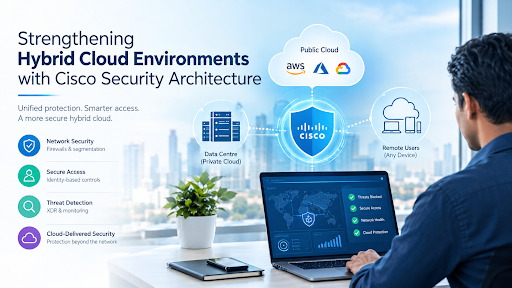
How Cisco Security Architecture Supports Hybrid Cloud Protection
An effective security architecture connects different layers of protection so that organisations can monitor activity, manage access, and respond to threats more consistently.
Cisco offers security technologies that address network protection, endpoint security, secure access, and threat detection. Depending on business requirements, organisations can combine suitable solutions to protect users and workloads across hybrid environments.
Important components include:
1. Network Security and Firewall Protection
Firewalls help control traffic entering and leaving networks according to defined security rules. They can inspect connections, identify suspicious activity, and restrict unauthorised communication.
Cisco Secure Firewall solutions help organisations apply network security controls, while network segmentation can limit unnecessary communication between systems. This is particularly useful when sensitive applications need to remain separated from less critical workloads.
2. Secure Access for Distributed Users
Employees increasingly access business applications from offices, homes, and other locations. Traditional network boundaries alone are not enough to protect these connections.
Cisco security technologies support secure access through identity-based controls and solutions such as Cisco Secure Access. Organisations can apply access policies based on user identity, device context, and application requirements, helping reduce unnecessary access to business resources.
3. Threat Detection and Response
Threat detection helps security teams identify suspicious behaviour before it develops into a larger incident. Integrated security monitoring can provide useful information across networks, endpoints, email, and cloud environments.
Cisco Extended Detection and Response (XDR) capabilities can help security teams investigate related security signals and coordinate responses. This can improve visibility and support faster investigation when suspicious activity is detected.
4. Cloud-Delivered Security
Cloud-delivered services extend protection beyond the traditional office network. For example, Cisco Umbrella provides DNS-layer security and other cloud-delivered protection capabilities that can help defend users against malicious internet destinations.
These services are particularly relevant when employees work remotely or use cloud applications outside the corporate network. Their effectiveness depends on appropriate configuration, policy enforcement, and integration with the organisation’s wider security controls.
Applying Zero Trust Across Cloud and Network Resources
Zero trust is a security approach based on the principle that access should not be automatically trusted simply because a user or device is connected to a corporate network.
Instead, organisations verify identities, evaluate access requests, and apply permissions according to business needs. This approach supports hybrid cloud security by helping protect resources regardless of where they are hosted.
Businesses can strengthen zero-trust practices by:
- Using multi-factor authentication for important systems and applications.
- Giving employees access only to the resources required for their roles.
- Reviewing permissions regularly and removing unnecessary access.
- Monitoring unusual login patterns and suspicious activity.
- Separating critical workloads to reduce the potential spread of threats.
These measures can help reduce exposure if an account is compromised. They also support more consistent security policies across private infrastructure and public cloud platforms.
Building a Consistent Security Strategy Across Environments
Technology alone cannot create a secure hybrid cloud environment. Organisations also need clear policies, defined responsibilities, and regular reviews of their security posture.
A practical implementation strategy should include the following steps:
- Assess the existing infrastructure: Identify where applications, workloads, and sensitive information are stored. Review existing security tools and determine where visibility or access controls may be lacking.
- Define security requirements: Establish policies for authentication, network access, data protection, monitoring, and incident response. Requirements should reflect the sensitivity of information and the needs of each business unit.
- Integrate suitable security solutions: Select technologies that address identified gaps and work with the existing infrastructure. An integrated approach can reduce isolated security processes and improve coordination.
- Monitor and review continuously: Review security alerts, access permissions, firewall rules, and system configurations. Regular assessments help organisations identify changes that could introduce new risks.
- Prepare for incidents: Develop clear procedures for investigating threats, containing affected systems, restoring services, and communicating with relevant stakeholders.
Together, these steps help organisations establish a more structured approach to cloud network security while maintaining the flexibility of a hybrid cloud model.
Improving Visibility Without Increasing Complexity
Using too many disconnected security tools can make it difficult to understand what is happening across an organisation’s IT environment. Teams may need to switch between multiple dashboards, investigate duplicate alerts, and manually connect information from different systems.
An integrated architecture can improve visibility by bringing relevant security information together and supporting more coordinated responses. Centralised management, automation, and clear reporting can also help IT teams focus on significant risks rather than repetitive administrative tasks.
However, integration should be planned carefully. Businesses need to evaluate compatibility, licensing, performance, staffing requirements, and the security capabilities they actually need. The objective is not simply to deploy more tools but to create a manageable security environment that supports business operations.
Creating a Secure Foundation for Hybrid Cloud Growth
Hybrid cloud adoption can help businesses respond to changing technology requirements, but security must evolve alongside infrastructure. Strong access controls, network protection, threat monitoring, and consistent policies help organisations reduce risk while keeping applications and information accessible to authorised users.
For organisations looking to implement or improve their security architecture, Konverge is a strong option to consider. Its Cisco security portfolio includes firewall solutions, cloud-delivered security, zero-trust capabilities, and threat detection technologies, supported by services covering solution design, implementation, and ongoing optimisation. With the right assessment and deployment approach, businesses can build a more resilient hybrid environment using Cisco cloud security to support secure connectivity, better visibility, and controlled access across their digital infrastructure.
Recent Posts

Building a Scalable Data Storage Infrastructure for Long-Term Business Growth
October 22, 2026
No Comments
Read More »

Integrating Meeting Room Technology with Enterprise IT Infrastructure
October 15, 2026
No Comments
Read More »