
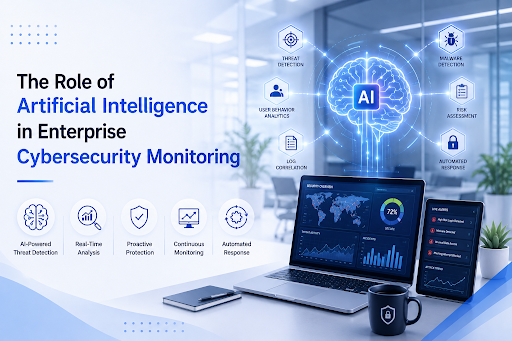
The Role of Artificial Intelligence in Enterprise Cybersecurity Monitoring
Posted By: Konverge Marketing
August 15, 2026
As the nature of cyberattacks continues to become more complicated and advanced, companies can no longer solely depend on standard cybersecurity techniques to counter them. Modern-day attacks are fast, more sophisticated, and in many cases likely to bypass security systems based on pre-defined rules. It is at such times that the power of Artificial Intelligence (AI) comes to help in detecting, analyzing, and reacting to such cyber threats. Using automation combined with intelligent decisions, AI is set to become an important aspect in enterprise network security.
Why Traditional Cybersecurity Monitoring Is No Longer Enough
Traditional cybersecurity monitoring techniques depend mainly on predefined rules and signatures of attacks. Such a technique is important, but it still faces challenges when trying to detect new and evolving attacks.
Organizations today have to control thousands of devices, applications, end users, and a lot of information. It takes a lot of time to monitor everything manually and is very inefficient, as well as susceptible to errors made by people. Hackers also use automation and Artificial Intelligence techniques, and that makes it hard for businesses to respond in time.
Artificial Intelligence can overcome these issues because it constantly learns from the network and responds much faster than any other technique.
How AI Improves Cybersecurity Monitoring
The benefits AI brings to cybersecurity lie in its ability to process huge amounts of data in real time. Rather than looking for known attacks, it recognizes anomalous behaviors that could point to threats.
Some of the capabilities of the technology include:
- Recognizing anomalous user behavior to detect the threat at an early stage.
- Discovering malware variants that are not recognized by signature-based solutions.
- Prioritizing high-risk alerts to avoid alert fatigue.
- Automation of the investigation and remediation of the threat.
- Continuous learning of new attack techniques using machine learning.
This makes it possible to pay more attention to strategic decisions than to routine work with thousands of alerts.
Faster Threat Detection Through Intelligent Analysis
Another major advantage of AI technologies is the ability to analyze huge amounts of security data in just a few seconds. Each login attempt, each application access, each event at endpoints, and any network activity generates data that could be used to detect the threat.
AI-driven monitoring technologies correlate these events in different environments in order to discover suspicious behavior that otherwise would stay undetected.
For instance, when an employee account suddenly logs into multiple countries in several minutes and at the same time downloads sensitive information, AI can immediately spot this anomaly, classify it as a threat, and apply predefined security procedures.
This level of intelligent monitoring significantly strengthens enterprise network security by enabling organizations to detect threats before they cause significant damage.
Reducing Response Time During Security Incidents
Quick detection of security threats is only half of efficient cybersecurity practices. Quick response is another important aspect of the process.
AI allows for automated incident response through carrying out predefined actions, such as:
- Isolating the affected devices from the rest of the corporate network.
- Blocking suspicious IP addresses.
- Disabling user accounts that are already compromised.
- Sending notifications with information about the detected incident.
- Starting automated investigation workflows.
All of these measures limit the window of opportunity of attackers in terms of lateral movement and minimize the impact of security incidents in general.
Predictive Security Rather Than Reactive Protection
Unlike other security solutions that deal with a threat only after it happens, AI technology enables organizations to predict risks before they happen.
Machine learning systems constantly analyze past attack patterns, behavior, device usage, and vulnerabilities to detect where there is a heightened risk. This way, cybersecurity specialists will be able to harden the security infrastructure before any attacker takes advantage of the weaknesses.
Proactive protection against threats moves cybersecurity away from reactive measures and towards preventative actions that allow companies to get ready for cybercriminals.
Supporting Security Teams Instead of Replacing Them
While AI is very effective, it doesn’t substitute for human cybersecurity specialists. Rather, it acts as an intelligent assistant, making work more efficient.
Human specialists are essential in such processes as:
- Handling sophisticated incidents.
- Making security-related decisions.
- Meeting the requirements of compliance.
- Combating advanced targeted attacks.
- Enhancing company security policies.
AI helps to automate mundane monitoring processes to enable specialists to engage in high-priority work that requires human expertise.
Building a More Resilient Cybersecurity Strategy
Deploying AI-enabled monitoring becomes particularly effective once it is integrated into a wider cybersecurity strategy. It is recommended that companies utilize AI along with traditional security systems, including endpoint security, cloud security, identity management, and network monitoring solutions.
Some other important elements of a good cybersecurity policy should include:
- Ongoing security assessment.
- Continuous training of employees.
- Strict access management procedures.
- Disaster recovery and backup planning.
- Continuous monitoring of hybrid and cloud environments.
Integrating all these strategies together with the use of AI technology allows for building numerous layers of protection that enhance the overall organization’s resilience to cyberattacks.
Driving Smarter Security for the Future
Artificial Intelligence is an indispensable tool for effective security monitoring in modern times. It is capable of threat detection, automated response, large-scale data analysis, and continuous learning from new types of attacks, thus becoming indispensable for those who aim to improve enterprise network security. In view of the changing nature of cyber threats, businesses that incorporate artificial intelligence security monitoring tools will have better chances of protecting their vital systems and information.
Organizations interested in enhancing their cybersecurity can always rely on Konverge for smart and future-proof solutions designed for today’s corporate environments. Through its experience in technologies such as Infrastructure Security Solutions, Networking Solutions, Managed Services, and Data Center, Konverge enables companies to create secure and robust IT infrastructures capable of meeting the cybersecurity challenges ahead.
Recent Posts

FortiGate Firewall: Key Features to Consider for Enterprise Network Security
September 10, 2026
No Comments
Read More »

How Cisco Collaboration Solutions Support Better Communication Across Modern Workplaces
September 1, 2026
No Comments
Read More »