
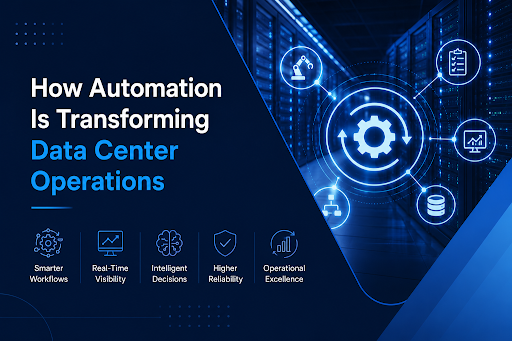
How Automation Is Transforming Data Center Operations
Posted By: Konverge Marketing
August 7, 2026
As companies adopt more technologies like cloud computing and artificial intelligence, data centers have emerged as the bedrock of contemporary IT architecture. Manual management of such an intricate ecosystem is not a realistic approach, given the demands for increased availability, improved performance, and better security from businesses. This is the stage at which data center management is changing through automation. Through automating tasks and intelligent monitoring, automation allows companies to enhance efficiency and reduce costs.
Why Traditional Data Center Operations Are No Longer Enough
Data center management traditionally included the process of controlling systems, distributing resources, solving problems, and performing other activities that required the involvement of people. However, the current data centers produce huge volumes of operational data each second. Therefore, conventional methods of data center management include numerous routine operations.
The consequences of manual data center management include:
- Slower incident response times
- Increased risk of human error
- Higher operational costs
- Resource underutilization
- Difficulty managing hybrid and multi-cloud environments
Automation helps organizations to solve these problems by letting the systems complete repetitive tasks fast, consistently, and accurately.
Intelligent Monitoring Improves Visibility
Another advantage of automation lies in continuous monitoring. The latest automated systems are capable of collecting and analyzing performance data related to servers, storage devices, networking hardware, and applications in real-time.
Unlike traditional systems, which can only alert administrators about problems after they occur, automated monitoring systems are able to detect patterns, issue alerts, and even start corrective actions prior to users noticing any problems.
Thanks to this ability, IT teams get an opportunity to:
- Detect performance bottlenecks early
- Increase uptime and reliability
- Constantly monitor the state of the infrastructure
- Reduce operational load on IT staff
The result is a more resilient infrastructure that supports business continuity.
Smarter Resource Allocation Through Automation
Data centers are continuously experiencing changes in terms of workload. Some applications need additional computing power during certain times of day, while some are completely idle at certain periods of time.
Automated resource allocation can be done through workload analysis and allocation of computing, storage, and networking resources. This would guarantee optimum resource utilization without requiring any manual intervention.
Automated resource allocation brings such benefits to organizations:
- Better server utilization
- Lower energy consumption
- Reduced infrastructure costs
- Improved application performance
- Faster workload balancing
These innovations help companies to grow and provide their services at a constant level.
Automation Enhances Data Center Management
Management of modern data centers requires coordination of multiple interdependent elements. Automation makes the management process easier due to the integration of monitoring, provisioning, security, maintenance, and reporting in one chain.
IT staff do not spend hours executing routine tasks and can dedicate more time to more important activities aimed at the development of the company.
Automated data center management offers several operational benefits:
- Automated provisioning of servers and virtual machines
- Policy-based configuration management
- Real-time infrastructure health monitoring
- Predictive maintenance using analytics
- Automatic software updates and patch management
- Faster disaster recovery processes
This increases the effectiveness of operations and reduces the number of manual interventions in the processes.
Predictive Maintenance Minimizes Downtime
Unexpected hardware failures can be costly for organizations that rely on uninterrupted services.
The use of automation technology in conjunction with artificial intelligence allows continuous monitoring and analysis of system performance to detect any signs of hardware deterioration. The hardware can be replaced and repaired to avoid any disruption to service provision.
The benefits of predictive maintenance include:
- Lower costs of maintaining hardware
- Fewer disruptions to services
- Higher durability of equipment
- Efficient planning of upgrades to hardware
In this way, the maintenance of systems is more efficient and protects business-critical applications from any risks.
Security Becomes Faster and More Responsive
New cybersecurity risks emerge on a daily basis. Manual management of security is becoming increasingly difficult to implement.
Automation allows for security to become continuous as it monitors the systems for suspicious activity and addresses it instantly. Automated security processes allow for isolation of vulnerable systems, implementation of security policies, and notifications about threats without requiring any human interference.
Among other advantages of automated security, we can mention:
- Faster threat detection
- Automated compliance checks
- Continuous vulnerability scanning
- Rapid incident response
- Consistent policy enforcement
Organizations can safeguard sensitive information and comply with regulatory requirements due to quicker response times.
Streamlining Disaster Recovery
It is crucial for businesses to be able to recover from unexpected disasters or system failures.
With the help of automation, disaster recovery becomes easier because backups will be scheduled automatically, workloads will be replicated, and recovery procedures will be executed in a timely manner without having to resort to lengthy manual processes.
Disaster recovery automation will allow you to:
- Reduce recovery time objectives (RTO)
- Increase recovery point objectives (RPO)
- Ensure consistent verification of backups
- Quickly restore services
- Enhance operational resiliency
All this preparation ensures minimal downtime and lower costs incurred as a result of the disruption.
Supporting Hybrid and Cloud Environments
Most organizations nowadays no longer use one on-premise data center only. Hybrid IT infrastructure is what most modern organizations have today, which consists of physical infrastructure, virtualization platforms, and multiple cloud service providers.
Automation allows you to get centralized visibility and standardized management of all these environments. This means that administrators will be able to deploy applications and workloads, monitor performance, and enforce policies from a single platform without having to switch between several environments.
This will make the process much more efficient and easier to manage when it comes to infrastructure management on a larger scale. As companies start adopting a hybrid approach, automation will be vital for retaining flexibility and scalability.
Building a Future-Ready Infrastructure
In this day and age, automation cannot be considered an option for enterprise data centers. Rather, it is a necessity considering how the complexity of IT environments is growing day by day. Intelligent automation can help organizations optimize processes, minimize the risks related to these processes, enhance security, and offer service availability. If you want to upgrade your IT environment, you must focus on scalable and resilient solutions.
For those organizations that seek knowledge from experts, Konverge is here for them because it provides advanced technological solutions, based on the company’s years of experience in IT infrastructure for enterprises. From Networking Solutions and Cloud Solutions to Managed Services and Data Center solutions, Konverge helps businesses build intelligent, automated environments that support reliable data center management and long-term digital transformation.
Recent Posts
FortiGate Firewall: Key Features to Consider for Enterprise Network Security
September 10, 2026
No Comments
Read More »
How Cisco Collaboration Solutions Support Better Communication Across Modern Workplaces
September 1, 2026
No Comments
Read More »