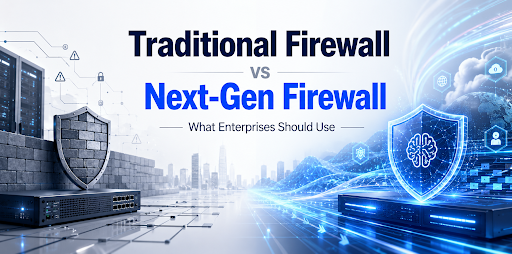
Traditional Firewall vs Next-Gen Firewall – What Enterprises Should Use
Posted By: Konverge Marketing
May 22, 2026
With the ever-changing cyber environment, companies need something more than the standard security features. Nowadays, cyber attacks aim to exploit applications, individuals, and information rather than network traffic. Due to these factors, enterprises should reconsider their security strategies in regard to using either a standard or next-generation firewall. It is important to understand the difference between the two products.
Understanding Traditional Firewalls
Traditionally, a firewall provides the primary layer of security by observing and regulating traffic in and out of an enterprise based on specific rules. The main tasks include:
- Packet filtering
- Stateful inspection
- Port and protocol-based traffic control
Although these functions help protect networks against standard threats, they do not provide insight into the activity of applications, which can be vital in terms of detecting more complicated cyber attacks like encryption or malware.
A standard firewall is sufficient for protecting smaller enterprises or companies that are less likely to be affected by cyber-attacks. For large-scale organizations, it may not prove to be effective enough.
What Makes Next-Gen Firewalls Different?
While a traditional firewall is simply an access control system, a next-generation firewall combines security functions in one package that includes the following features:
- Deep packet inspection
- Intrusion prevention system (IPS)
- Awareness and control over applications
- User identification
- SSL inspection
In contrast to legacy firewall technology, next-generation firewalls are capable of providing greater visibility of network operations. They can even specify particular applications and behavior patterns, as well as the users that cause those patterns.
This high level of sophistication fits perfectly into corporate needs, particularly when cloud computing and mobile devices are involved.
Key Differences That Matter to Enterprises
While looking at the two solutions together, the disparities between them will be evident in the following aspects:
1. Visibility and Control
The first difference will be in visibility and control, as conventional firewalls lack the capacity for insight into user activity, while next-generation solutions allow full insight into applications and users.
2. Threat Detection
Next-generation solutions have the ability to recognize advanced persistent threat (APT) attacks while traditional solutions do not.
3. Performance and Integration
Firewall solutions have evolved to provide multiple services in a single system.
4. Adaptability
Companies need adaptable solutions since security requirements change over time, and next-generation solutions provide flexibility.
Companies such as Konverge adopt a strategic approach in implementing network security using firewall solutions and appropriate implementation and monitoring mechanisms. In essence, firms should not only implement technologies but also ensure that they do so successfully.
When Should Enterprises Upgrade?
Not all companies need to migrate their firewalls, but there are certain scenarios when it becomes imperative to do so:
- Increased usage of cloud applications
- Hybrid work environment
- Processing confidential customer or financial information
- More instances of cybersecurity attacks
In some situations, organizations cannot afford to stick to traditional firewalls since they leave openings through which attackers could gain access.
A Smarter Approach to Enterprise Security
Selecting the most suitable firewall type between the traditional and modern options is a matter that depends not only on the technicality but also aligns with the organization’s needs. Next-generation firewalls provide a deeper level of functionality, intelligent capabilities, and adaptability to deal with the emerging environment.
When it comes to network security for companies, collaborating with professional organizations such as Konverge will play a huge role in securing the environment. The expertise provided by them allows the organizations to adopt the solutions efficiently.
With the growing need for digitalization, security should be an essential aspect for all businesses. Integrating various security solutions, including network security, cloud security solutions, managed security services, intrusion prevention systems, and enterprise cybersecurity, becomes vital.
Recent Posts
The Role of Artificial Intelligence in Enterprise Cybersecurity Monitoring
August 15, 2026
No Comments
Read More »